

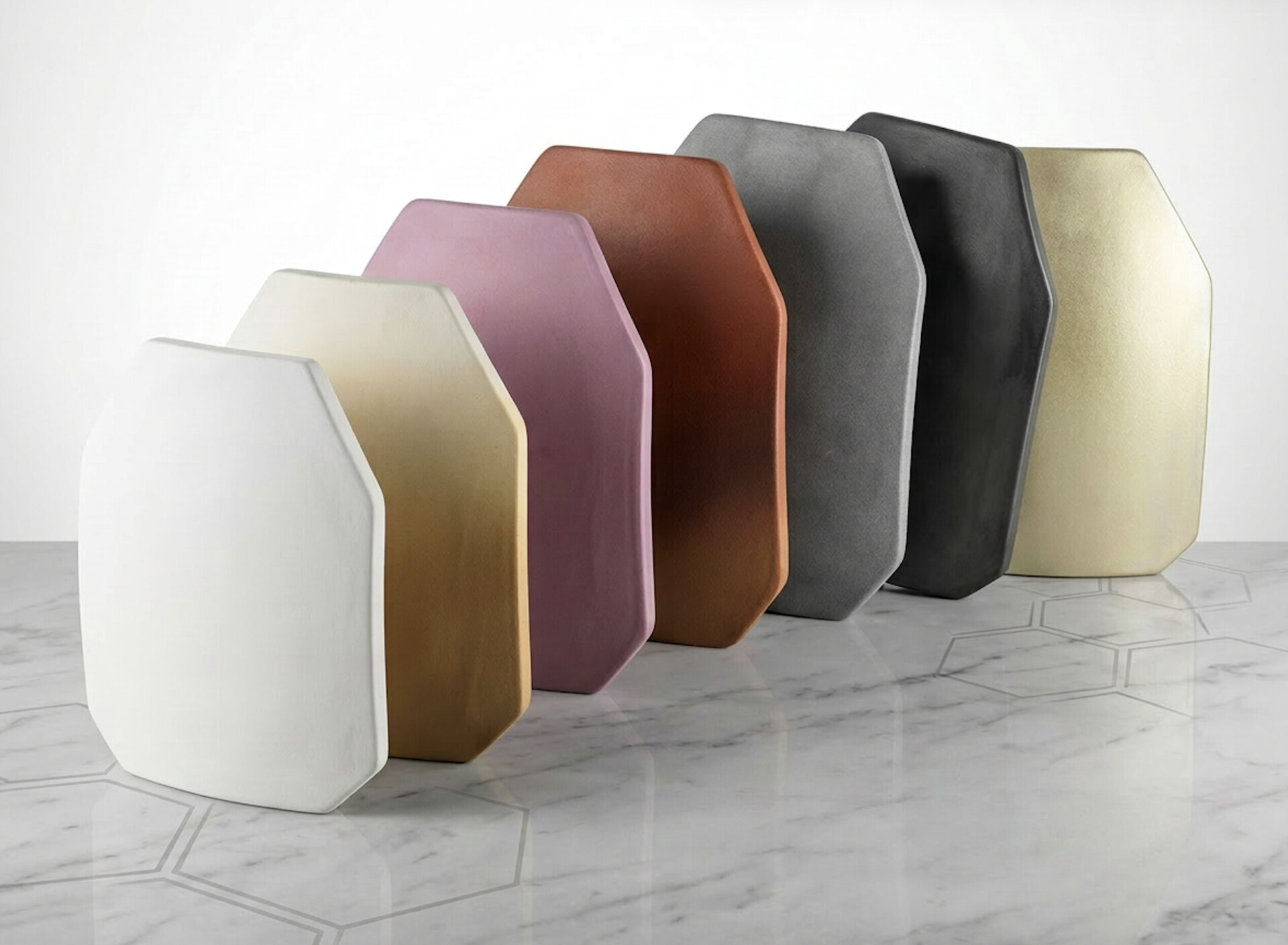

Though my company does not sell or work with aluminum oxide, as a chemist, I’ve always been interested in the remarkable ways in which alumina can be alloyed and doped — which affects not only its performance, but also its coloration in various striking ways.
Though pure alumina is white — in fact, it’s one of the whitest substances known — many alumina-based ceramic armor tiles are off-white or lighter-colored; many are slightly pink or salmon; some lean toward a brick-red or brown hue; and there are some that are gray, greenish, or almost black. These colors reflect the chemistry of the materials involved, including the types of minor oxides present, where they are located within the microstructure, and in what oxidation state. As such, the color of the ceramic may be a useful first-pass diagnostic and material-grading tool. Too blunt a tool to ever be a final judgment on the “quality” of a ceramic tile, but always, at the very least, an important clue.
If you do a lot of work with alumina, a color-calibration card – which could be as simple as some samples of sintered PTFE (“spectralon”), 99.9% alumina, and alumina-mullite – can be very useful for first-pass batch checking.
Why Pure Alumina Is White
Pure alumina is white because the ions that make up its corundum structure, Al3+ and O2-, do not have partially filled d-electron shells and therefore do not significantly absorb visible light. In a dense polycrystalline Al2O3 ceramic, light is instead scattered efficiently by the microstructure, so the material appears white.
Once other metal ions enter the system, that can change. Elements such as chromium, iron, titanium, manganese, cobalt, and nickel can introduce visible absorption bands. They may do so by dissolving into the alumina lattice, forming second phases, or segregating to grain boundaries and other interfaces.
The underlying physics is crystal field theory. Transition-metal ions in an oxygen-coordinated environment undergo d-orbital splitting, and electrons can absorb specific visible wavelengths as they move between those energy levels. The remaining wavelengths are reflected or transmitted, producing color. This is why ruby is red, sapphire can appear in many different colors, and alumina armor tiles can range from pink to brown, gray, or black.
One important caveat follows from this immediately: Color does not always mean the same thing. It may result from residual impurities carried over from powder refining, intentionally added dopants or sintering aids, second-phase particles at grain boundaries, or redox conditions during firing. Lumping all of these together under the label of “impurity” throws away most of the useful information.
White
If a tile is a more-or-less pure white, it generally implies a relatively high degree of purity and a good deal of cleanliness in the microstructure. Even this requires qualification, however. Very small amounts of iron- or titanium-based residual oxides can shift a tile from bright white to ivory without degrading its quality. Sodium – a common product of the Bayer process used to refine bauxite into alumina – is particularly relevant. While sodium oxide is not typically a chromophore in the classical sense, it can affect sinterability and secondary-phase chemistry, resulting in tile coloration that is slightly “off.” An off-white tile is not necessarily indicative of poor-quality material. Rather, it simply indicates that the material’s optical properties are not perfectly ideal – which is true for virtually all real-world industrial aluminas.

The very purest and cleanest alumina ceramics are as white as the driven snow, and translucent if you hold them to a strong light.
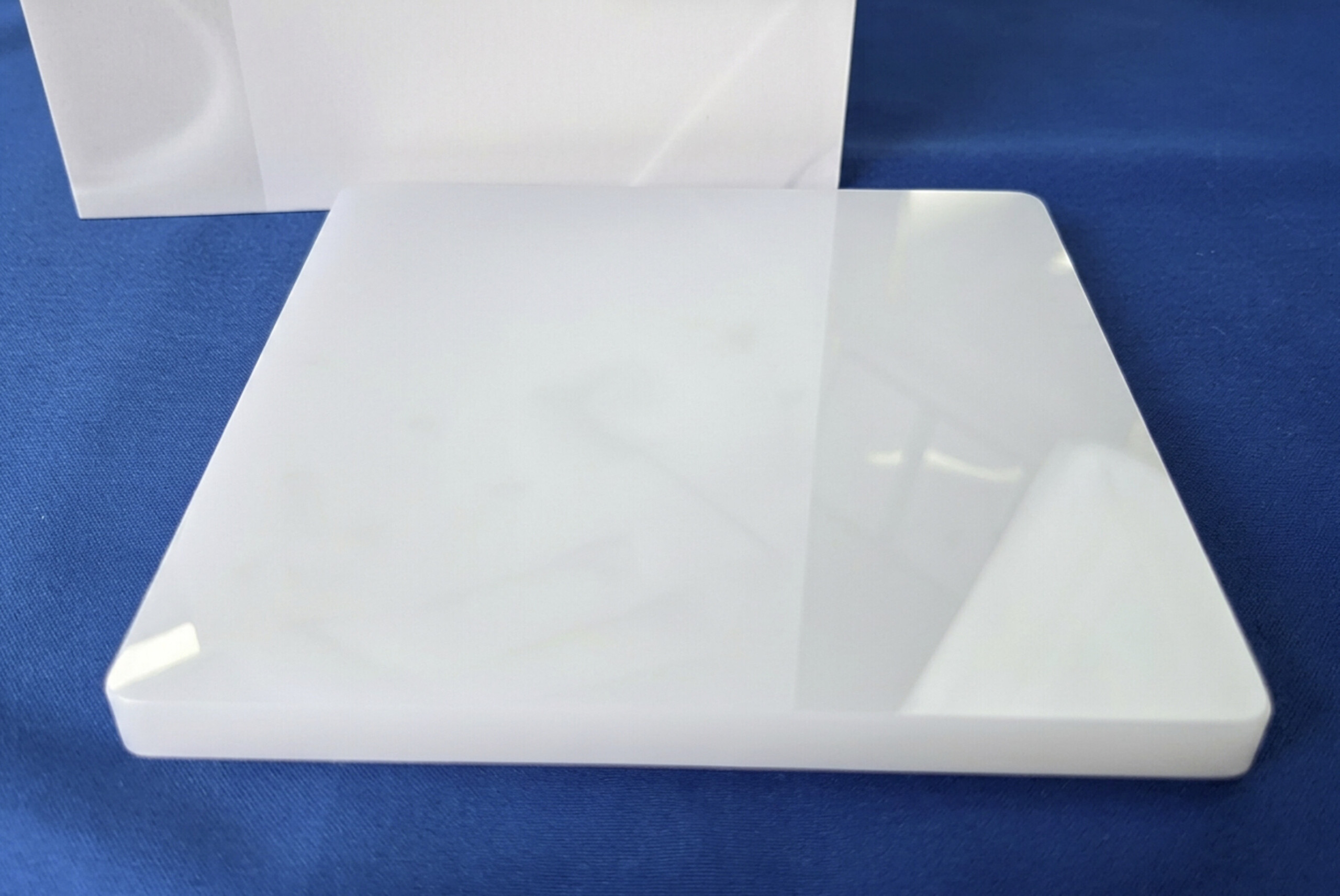
Contrary to an oft-repeated claim, there is no exotic sunlight or hydration mechanism that turns pure alumina off-white or yellowish. Its color is generally stable.
Pink – Usually Chromium, But Not Always Bad
Pink alumina is where nuance matters most. Chromium (Cr2O3) is by far the single largest contributor to pink coloration in alumina. Furthermore, Cr2O3 shares a corundum structure with Al2O3 and can form complete solid solutions across the entire composition range at high enough temperatures, with a miscibility gap only at lower temperatures and under specific conditions. To put this another way: Chromia is fully compatible with alumina – both structurally and chemically.
On account of this compatibility, chromia has historically been employed as a functional alloying addition in alumina. Cr2O3 acts as a property-modifying additive that can alter grain growth characteristics, hardness, elastic modulus, fracture toughness, flaw tolerance, and high-temperature wear resistance. One study demonstrated that small amounts of Cr2O3 resulted in a bimodal microstructure consisting of larger plate-like grains in a finer matrix. This altered microstructure exhibited enhanced fracture toughness and R-curve behavior while simultaneously improving hardness and elastic modulus (although flexural strength decreased).

Thus a pink tile is not automatically a dirty tile. It could be sub-optimal, but it’s usually an alumina containing chromia whose pink color represents intentional chemical modification rather than the result of using low-grade raw materials. Where ballistics are concerned, the rule of thumb is that chromia-alloyed alumina will exhibit better multi-hit performance – on account of improved fracture toughness and grain size distribution – but slightly inferior absolute single-hit performance due to lower hardness.
The Chromium Color Progression
The way alumina’s color changes with increasing amounts of chromium is generally poorly described. Alumina with small amounts of chromium (less than approximately 1 weight percent Cr2O3) tends to produce pastel pink. As the amount of chromium increases, the color first deepens to magenta, and then shifts to gray. This gray zone involves increasing opacity from pair-absorption processes: Exchange-coupled Cr3+-Cr3+ pairs produce broad absorption features that flatten the reflectance spectrum, suppressing the selective absorption that created the pink/magenta hue and replacing it with a generally darker, less chromatic appearance. Only at much higher levels of chromium – greater than approximately 80 weight percent Cr2O3 – does distinct green appear as alumina becomes the minor component and green Cr2O3 dominates.
Therefore, while there is some truth to the common characterization that “the addition of more chromium will make pink tiles turn green,” it is an oversimplification. The transition typically proceeds through stages: Salmon, pink, magenta, gray, and then green, with the last stage only after the material has reached extremely high levels of chromia. Green alumina therefore cannot be characterized simply as having “a bit more chromia than a pink alumina.” It probably has no chromia at all. Instead, it almost certainly represents a different, and potentially less conventional, chemical formulation — probably a chemically mixed transition metal system, similar to those that cause green colorations in sapphires and spinels (mixed iron, cobalt, and nickel oxides).
Brick Red and Brown — Usually Iron
Brick reds and browns tend to occur in response to iron. Alumina tiles are derived from bauxites, which are drawn primarily from clay minerals and other hydrated aluminum silicates. However, these same clays also contain residual iron oxides. Consequently, low- and medium-grade alumina powders are rarely pure white. Depending on concentration and local chemistry, iron may be present as substitutional Fe3+ in the lattice, as discrete iron-rich second phases, or as material concentrated at boundaries and inclusions. The more the color resembles hematite or rust rather than pale ruby, the more cautious one should be about assuming the color comes from clean lattice substitution alone.

This is not to say that every reddish-tinted tile is sub-optimal for use in armor. Rather, it indicates that the probability of finding deleterious impurities accompanying the iron oxide (e.g., silica, calcia, soda) is higher. These impurities can create conditions conducive to the formation of glasses along grain boundaries – a kind of microstructure more typical of cost-driven structural ceramic formulations than of the cleanest high-performance armor ceramics.
Pale Gold — A Rare Earth Contribution
Ceria additions to alumina, which turn the ceramic straw- to honey-colored, represent another case where color does not automatically mean contamination. CeO2 is an emerging alloying and doping additive in alumina. Interestingly, CeO2 has very low solid solubility in alumina, so it usually does not behave like a clean substitutional dopant the way Cr2O3 does. Instead, it tends to segregate to grain boundaries and triple points, where it can pin grain growth, alter densification, and in some processing windows improve the transparency or microstructural uniformity of the final ceramic.

Under more reducing conditions, ceria becomes somewhat reactive, and some of the cerium therein can shift toward Ce3+, which changes its interfacial behavior further. In that state, cerium can also react with alumina to form cerium aluminate phases such as CeAlO3 and CeAl11O18. These compounds can materially change grain-boundary chemistry, phase balance, crack deflection behavior, and the final mechanical response of the tile. Ceria-modified zirconia is already established as a premium wear and impact resistant industrial material, but the utility of ceria-doped alumina in armor systems has yet to be fully determined.
Gray and Black — Not Just Carbon
There are several reasons why alumina tiles may appear dark gray or black. Incomplete binder removal resulting in the presence of carbon residues and/or reduced transition metals is one possibility. That said, the mere absence of binder residue does not exclude the possibility of darkening being caused by dopants or additives.
Oxidized manganese compounds are known to be dark gray to black, and Mn3O4 has been employed in various types of ceramic products, including alumina, as a densification aid or ceria-type microstructural modifier. Indications are that it generally improves rather than reduces performance, by refining grain size and improving densification. Mn3O4-modified alumina would be dark gray.
The vanadium oxide V2O3 is black, and vanadium oxide impurities can turn alumina black, but V impurities are uncommon, and are practically never added to alumina intentionally, so they are unlikely to be encountered.
Alumina cermets — where a metal powder is added to the ceramic before sintering, usually for toughening or to promote a certain tile chemistry — are typically gray to black. And of course every grade of alumina that contains free carbon, carbon nanotubes, or graphene will be optically dark gray to black.
How Color Relates to Density
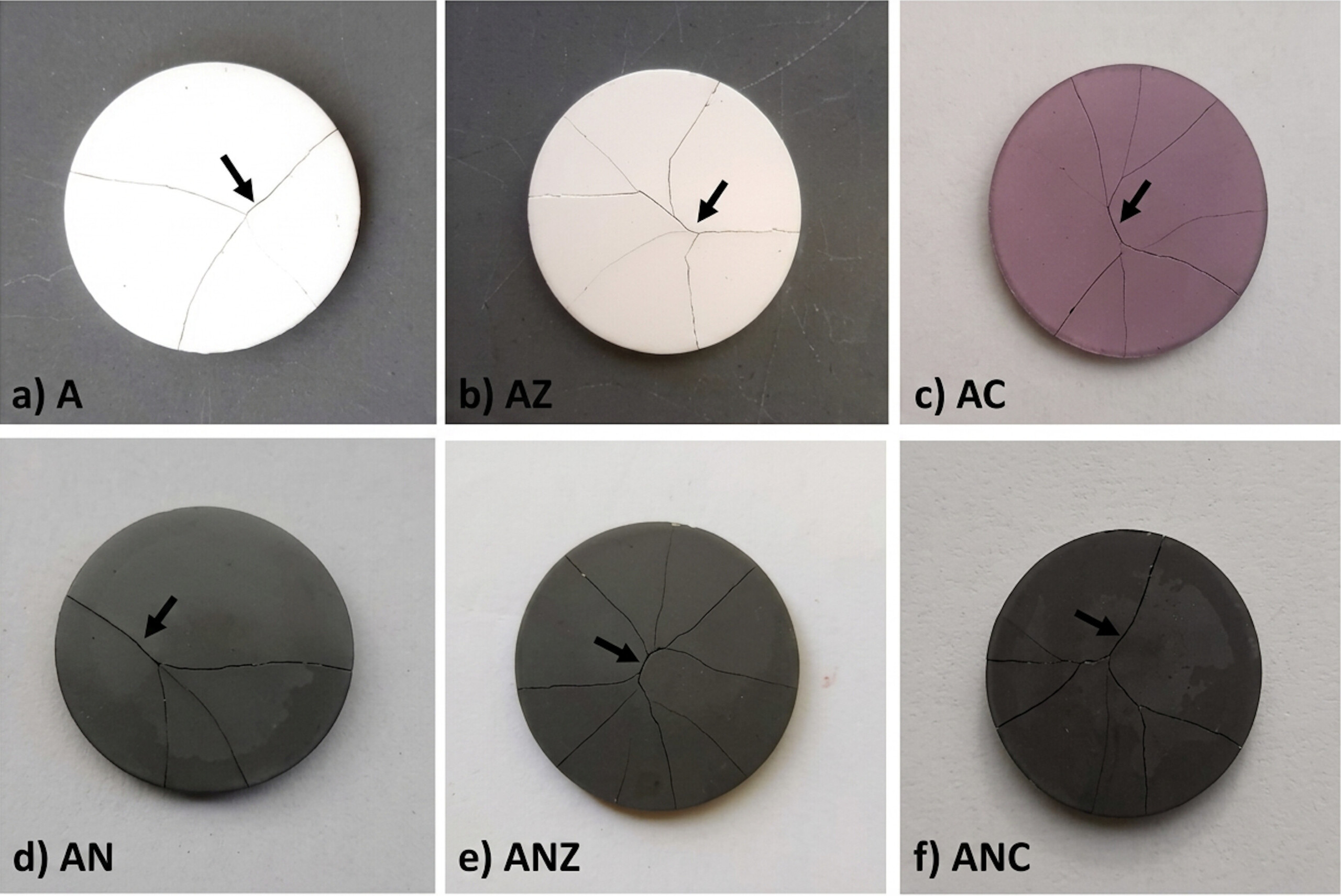
As just about all of the aforementioned oxides – from Cr2O3 to V2O3 to the iron oxides– are much denser than Al2O3, it’s fair to ask whether pink or red tiles are heavier than white ones. The answer is: Not really. Trace amounts of transition metal oxides will make little difference in terms of overall density provided that porosity remains constant. But once you move from trace coloration into real chromia alloying, you can get meaningful density increases. The density of an alumina ceramic tile can go from 3.99 to 4.14 gm/cc as Cr2O3 content increases from 0 to 17.5 wt% in dense hot-pressed alumina-chromia bodies. (Though, to reinforce my previous point, even the addition of chromia at 17.5% results in a mere 3.7% density increase.)
How Color May Relate to Ballistic Performance
The following is a rough guide to what alumina tile color may imply for ballistic-relevant properties, assuming a dense ceramic with minimal porosity. As mentioned previously, color is a clue, not a verdict; it can suggest likely chemistry and likely tradeoffs, but it should never be treated as a substitute for actual compositional analysis, density measurement, hardness testing, and ballistic evaluation.
Pure white
A pure white tile most likely indicates high-purity alumina. In ballistic terms, this generally points toward excellent hardness and moderate fracture toughness. In other words, it is a good sign for strong single-hit performance, though not necessarily for the best toughness or multi-hit resistance.
Off-white to straw
An off-white, ivory, or slightly straw-colored tile suggests the presence of an impurity load, which is most likely to be a small amount of Na2O, SiO2, ZrO2, or related residual oxides and secondary phases. This may correlate with slightly reduced hardness and density, along with modified fracture toughness and wear resistance. The exact effect depends heavily on the type of impurity involved, because not all impurities behave in the same way. Low-cost industrial alumina tiles are typically off-white and contain substantial volumes of SiO2 which simultaneously reduces density, hardness, and fracture toughness.
Pink
A pink tile suggests Cr2O3 doping, and this is typically intentional. In practical terms, chromia-alloyed alumina generally shows somewhat reduced hardness, improved fracture toughness, improved wear resistance, and very slightly increased density. The likely ballistic tradeoff is better multi-hit behavior, but slightly inferior absolute single-hit performance compared with very pure white alumina.
Brick red to brown
Brick-red, reddish-brown, or brown tiles usually indicate iron oxides, typically at meaningful levels. These compositions may be expected to exhibit slightly reduced hardness, slightly increased density, and potentially reduced fracture toughness, especially if the iron is accompanied by silica, calcia, soda, or other impurities that promote glassy grain-boundary phases. That said, if iron oxide is carefully and intentionally added as a dopant in small amounts, it may have an effect similar to chromia’s but smaller in magnitude.
Gray to black
Gray or black alumina can result from several different causes, including manganese or vanadium oxides, metallic additions, carbon, or other darkening additives and phases. The performance implications are therefore highly variable. Manganese additions can improve densification and refine grain structure, which may be beneficial. Metallic additions increase density and are generally undesirable for ceramic armor. Carbon-containing systems may be beneficial or harmful depending on how the carbon is incorporated and what it does to the microstructure.
Straw to pale gold
A straw-colored, honey-colored, or pale gold tile may indicate CeO2 doping or related ceria-based grain-boundary engineering. This is a more unusual case. In principle, ceria-modified alumina may offer microstructural advantages and could even prove superior in armor applications, but as of 2026 that remains somewhat speculative. A darker straw or deeper gold color may suggest more strongly reduced ceria, a heavier ceria-derived phase content, or a mixed system involving both ceria and iron.
Any other color
If the tile falls outside these broad categories, it likely reflects a more unusual or exotic chemistry. In such cases, color alone is not enough to support even a preliminary performance judgment. The material should be investigated directly rather than interpreted by analogy.
Bottom line
If you are trying to assess alumina tiles quickly, color can be a useful first-pass diagnostic. White usually points toward purity and hardness. Pink often points toward chromium-modified toughness. Red-brown often warrants caution because iron-bearing systems are more likely to bring along undesirable grain-boundary chemistry. Gray, black, straw, and gold tiles are more chemistry-dependent and require more careful interpretation. But in every case, color is only a clue. The real determinants of ballistic performance remain composition, porosity, grain structure, phase distribution, hardness, toughness, and overall tile quality.






This is a great article, especially for those who don’t regularly work with Alumina.