

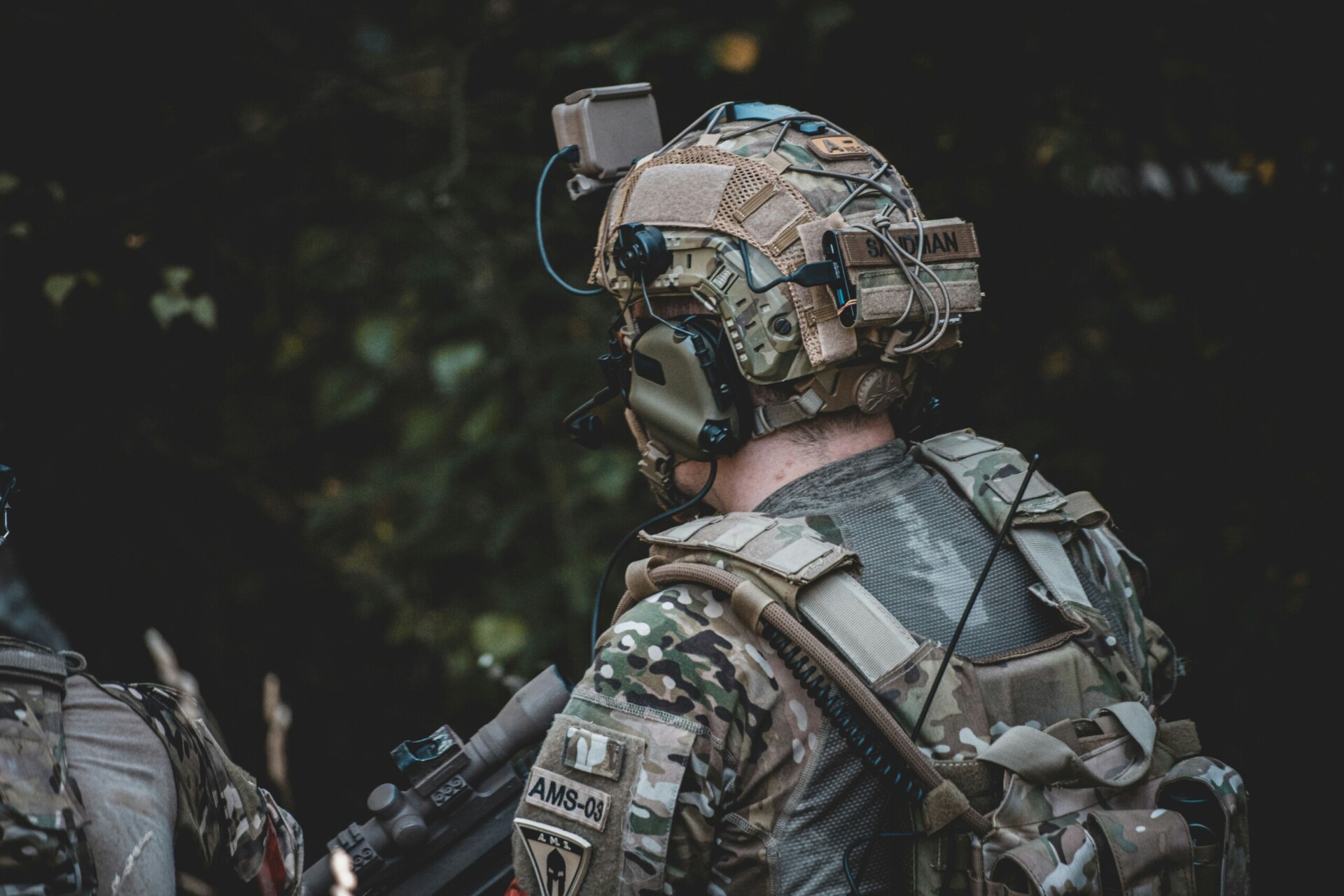

Modern warfare is evolving at a pace few industries can afford to ignore, least of all the body armor sector. According to Steve Heaword, Technical Director at CRIB Gogh, a part of Point Blank Enterprises Group, recent conflicts, particularly the war in Ukraine, have exposed critical gaps in traditional protection strategies while accelerating innovation in others.
“The dynamics of warfare are constantly changing,” Heaword explains.
“What we’ve seen in Ukraine is a rapid shift toward drone warfare and asymmetrical threats, and that’s fundamentally changing protection priorities.”
The Drone Factor: A Game-Changer
Perhaps the most disruptive development has been the widespread use of drones. No longer limited to surveillance, drones now deliver explosives with precision, forcing a re-evaluation of personal protective equipment (PPE). As a result, governments and defense organizations are increasingly prioritizing protection against fragmentation, improving resilience to overhead and indirect attacks, and ensuring adaptability in trench and static warfare environments. For manufacturers, this shift requires a broader rethinking of protection, not just improving armor plates, but designing integrated systems capable of responding to these emerging threats.
Beyond Ballistics: System-Level Protection
Heaword emphasizes that modern protection is no longer about stopping bullets alone. Advances in armor development now depend on a combination of material innovation, rigorous testing, and real-world applicability.
“We’ve had to enhance materials and refine our engineering to better protect soldiers in real combat environments,” he says. “It’s not just about the armor, it’s about testing, quality assurance, and ensuring reliability under evolving threats.”
This approach involves leveraging advanced material science to improve durability and weight efficiency, implementing stricter quality control protocols to ensure consistency, and conducting scenario-based testing that reflects the realities of modern combat rather than controlled laboratory conditions.
The Rise of Domestic Production
Geopolitics is also reshaping supply chains. While the United States has long enforced domestic manufacturing requirements through policies like the Berry Amendment, Europe is now moving in a similar direction.
“There’s a clear shift toward domestic capability and national security in production,” Heaword notes. “We expect that trend to accelerate over the next few years.”
For global companies, this creates both challenges and opportunities, requiring them to maintain flexible manufacturing footprints while balancing international collaboration with localized production demands.
Scaling Without Compromise
One of the industry’s biggest tests is scalability. In times of crisis, demand can surge rapidly, placing immense pressure on manufacturers to deliver without sacrificing performance or reliability.
“You can’t have capability if it’s not ready,” Heaword states. “We focus on ensuring that we can scale production rapidly without sacrificing quality.”
This means maintaining ready-to-deploy inventory, optimizing production systems for rapid expansion, and ensuring that every increase in output meets the same rigorous standards expected in lower-volume production. Increasingly, this ability to scale efficiently is becoming a defining factor for companies working with NATO-aligned forces.
Collaboration Is No Longer Optional
Looking ahead, Heaword is clear: no company, or country, can innovate alone. The future of body armor development depends on strong international partnerships that bring together expertise from multiple domains.
“International partnerships are essential,” he says. “Whether it’s material science, engineering, or production, collaboration is the key to staying ahead.”
Innovation is emerging simultaneously across Europe and the United States, and the ability to integrate these advancements into cohesive solutions will determine which organizations lead the next generation of protective technologies.
The Information Battlefield
Beyond physical threats, Heaword points to another growing challenge: misinformation. In an era where online platforms amplify unverified voices, distinguishing credible expertise from speculation has become increasingly difficult.
“There’s a lot of noise, people presenting themselves as experts without real knowledge,” he warns.
“That makes it harder for decision-makers and end users to separate fact from fiction.”
This issue extends into media and public discourse, where opinion-driven narratives can overshadow objective reporting. In an industry where decisions directly impact human lives, access to accurate, evidence-based information is as critical as the protective equipment itself.
Adapting to a Moving Target
The body armor industry stands at a pivotal moment. As warfare evolves, so too must the technologies designed to survive it. The increasing prominence of drone warfare, the shift toward domestic production, the demand for scalable manufacturing, and the necessity of international collaboration all point toward a future defined by adaptability.
Or as Heaword puts it:
“The truth is always three things, what you think it is, what I think it is, and what it actually is. Our job is to get as close to that reality as possible and protect people within it.”